 |
 |
 Order online or call now: 1-800-JUMP-USA (586-7872) |
|
|
Order online or call now: 1-800-JUMP-USA (586-7872) |

|
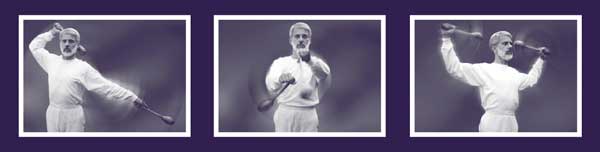
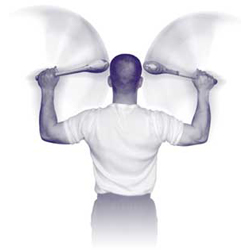
Working out with Indian Clubs might be described as Circular Weight Training. It develops rotary and angular or diagonal strength. Circular Weight Training will increase stability and prevent injury. You'll feel your shoulder muscles come alive! BASKETBALL: Loosen
your shoulders
to help you shoot and dribble with smoothness and accuracy.
TESTIMONIES
"I became interested in Indian Clubs several years ago after speaking with Vern Gambetta. What intrigued us about using the clubs was the training potential of extending the kinetic chain and being able to add resistance in all planes of motion. The clubs are definitely one of those training tools that have to be tried to be understood, but the main reason I use them is that they require you to be mindful rather than mindless in your movements. You learn to create fluid, graceful, precise movement patterns, and these patterns are great for your shoulders, elbows, and wrists especially. Baseball and volleyball players, Nordic skiers, and swimmers are some of the athletes who can benefit greatly by adding these functional, inexpensive and portable tools to their training program." Steve Myrland - Myrland Sports Training, LLC "There is just nothing like a workout with the clubs for general health, mobility and flexibility. It’s good for anyone but especially good for the martial artist because along with the loosening of the shoulder girdle it promotes coordination and strength in motion. Since I started using clubs about a year ago, I also found a heavier set and have been exploring lots of different exercises based on my practice of Filipino-Kali-Escrima." Stephen Browne - Martial Arts Instructer – Warsaw, Poland "I purchased a pair of Indian Clubs and video about a year ago for therapy of chronic shoulder pain. I have now been using the clubs for one year and have achieved a much greater range of motion and decreased pain. I have now prescribed the clubs to my patients who tell me of the same results. I would highly recommend the use of Indian Club Exercises for chronic shoulder pain and loss of range of motion." Dr. Mark Schmall D.C. - Chiropractor – Rock Island, Illinois "I love the Indian clubs
and the
exercises. They are deceptively strenuous! I suffer a lot of neck and
back
pain from sitting all day at a desk and the exercises really feel like
they’re helping, restoring a kind of balance in a way. I spin the tape
forwards and look at the more complicated moves and hope one day I get
there." "I’m 52 years of age – vocationally a government budget officer who spends way too many hours at a computer. Avocationally, I am a martial artist with over 35 years of practice – the last 15 or so in Southeast Asian martial arts (kali, silat, kuntoa, bando, gungfu, etc.). I have now been swinging Indian Clubs for a little over a year. The Ed Thomas video gave me the best instruction to date. The use of lightweight clubs helped loosen and strengthen the shoulder girdle which tends to get tight when I spend too many hours at a computer. The light clubs also helped my elbows and wrists that have been injured through martial arts practice. With the club swinging technique, I get full extension of the joints which I do not with more compact movements and exercises." Robert Eggebrecht- Chicago, Il "Indian Club training was introduced at the University about two years ago. Since then, our students have really gravitated to Indian Club exercises. The rhythm of Club Swinging has an appeal that feels almost primordial. I would rate Club Swinging as one of the best body/mind exercises that exist. The psychomotor control it develops is complex and exotic, stirring joy at every swing." Ken Daley - Associate
Professor
Department of Exercise and Sport Sciences, Maharishi University of
Management
Associate Editor of the SportScience Web Site |
|||||||||||





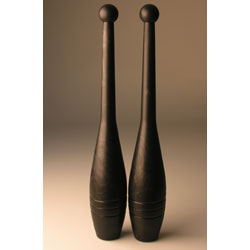
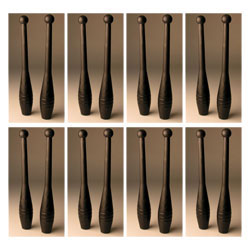 Indian Clubs Team Pack of
8
Indian Clubs Team Pack of
8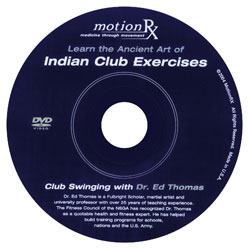 Indian Clubs DVD Only